


The Board of Peace, supported by the U.S., has put forward a proposal for a six-month, $2.45 billion plan aimed at initiating reconstruction and governance in Gaza, as President Donald Trump’s ceasefire initiative faces challenges.
During a meeting in New York on Wednesday, which coincided with the UN General Assembly, the board members revealed a comprehensive blueprint featuring 66 projects intended to kickstart efforts while recognizing significant obstacles that remain. These initiatives encompass ambitious plans for infrastructure, education, and healthcare, all designed to align with Trump’s 20-point strategy to resolve the Israel-Hamas conflict.
The board emphasized the vast need for assistance, estimating that full reconstruction of the physical damage in Gaza will require approximately $35.2 billion in the medium term and an additional $71.4 billion over the next decade.
This proposal primarily targets potential donors who will be approached to fund the reconstruction of the war-torn region.
The ceasefire, effective from October 10, 2025, was intended to pave the way for a comprehensive rebuilding process in Gaza under the oversight of the Board of Peace. The plan included further Israeli military withdrawals from Gaza, disarmament of Hamas, the deployment of an international peacekeeping force, and the establishment of a non-partisan Palestinian government to manage the daily affairs of the territory. It also laid out an ambitious vision for restoring Gaza, which has been devastated by war.
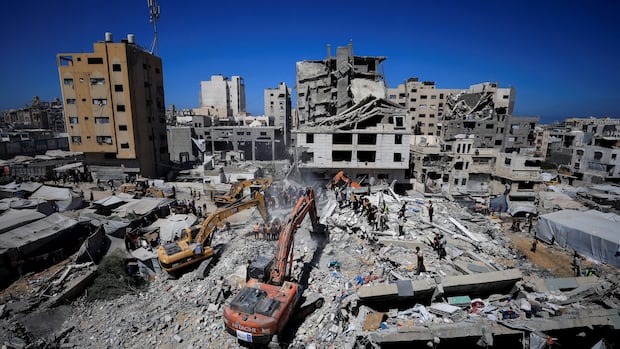
Rescue teams in Gaza City searched through the debris of an apartment building that collapsed unexpectedly overnight, resulting in the deaths of at least 21 Palestinians, including children, and trapping others beneath the rubble. The building had previously suffered damage from Israeli strikes and was sheltering displaced families, according to Gaza officials.
However, the U.S.-backed initiative has largely stalled. While the ceasefire has ceased the most intense fighting and improved humanitarian conditions, the Israeli military has expanded its presence in Gaza, now controlling around 60 percent of the area. Hamas has not relinquished its arms, and neither the international military force nor the new government has yet entered Gaza, leaving reconstruction efforts uninitiated. The majority of Palestinians continue to reside in tent camps or the ruins of their prior homes.
Nikolay Mladenov, the board’s high representative, indicated that progress is largely contingent upon Hamas disarming—a condition the group has refused to accept. He has also urged Israel to reduce its military operations.
“I want to make it very clear that we are not tied to a specific timeline,” he stated. “Our priority is to ensure the success of this initiative.”
The board faces critical questions, not only regarding the development of reconstruction plans but also concerning the timeline for deploying the international force meant to ensure security in the area, plans for disarming Hamas, and the provision of urgently needed construction materials.
-
Canada pledges $100M for Palestine at United Nations General Assembly
-
At least 21 killed in Gaza, including many children, as unstable building collapses
U.S. Gen. Jasper Jeffers, who is set to lead the planned international stabilization force for Gaza, outlined a five-step strategy for addressing the complex issue of demilitarizing Hamas. The strategy commences with the initial deployment of troops from Kosovo and Morocco, followed by additional personnel from Albania and Kazakhstan.
Their mission will focus on demilitarizing the region and dismantling all of Hamas’s military assets.
According to him, the objective is to gradually transfer security oversight to the interim government, after which Israeli forces are expected to withdraw.
Israeli airstrikes reportedly resulted in the deaths of at least four Palestinians in the Gaza Strip on Wednesday, with local health officials confirming the attacks, and Israel stating that one strike targeted a Hamas financial leader.
