

The Finance Minister, François-Philippe Champagne, has announced that the government will present its newest budget on November 5.
This marks the second budget under Prime Minister Mark Carney and the second consecutive budget to be unveiled in the autumn.
Historically, the federal budget was released in the spring, but Carney opted to shift the timing to fall beginning last year.
Champagne revealed the budget schedule during the question period on Tuesday.
In the government’s spring economic update released in April, a lower deficit for the last fiscal year was indicated compared to previous budget estimates. The 2025 budget had initially estimated a deficit of $78.3 billion for the 2025-26 fiscal year, but April’s update revised it down to $66.9 billion.
The increase in oil prices was one factor contributing to the favorable results in the spring update. For the ongoing fiscal year, the April update projected a deficit of $65 billion.
Champagne’s announcement coincided with the day the Parliamentary Budget Office (PBO) revised its economic growth projections for this year and the next.
In an updated forecast released on Tuesday, the federal budget watchdog forecasted a real GDP growth of 0.9 percent for this year and 1.5 percent in 2027.
These figures reflect a decline from the growth estimates of 1.1 percent and 1.6 percent, respectively, that were provided in June.
Annette Ryan, the parliamentary budget officer, cited “additional trade measures and ongoing uncertainty” as factors behind the revisions in the outlook.
Since the last PBO forecast, trade negotiations between Canada and the U.S. have collapsed, leading both nations to impose new tariffs on specific imports.
The PBO also adjusted its projection for the budget deficit to $63.3 billion for the fiscal year 2026-27, with expectations that it will peak at $70.2 billion in 2027-28.
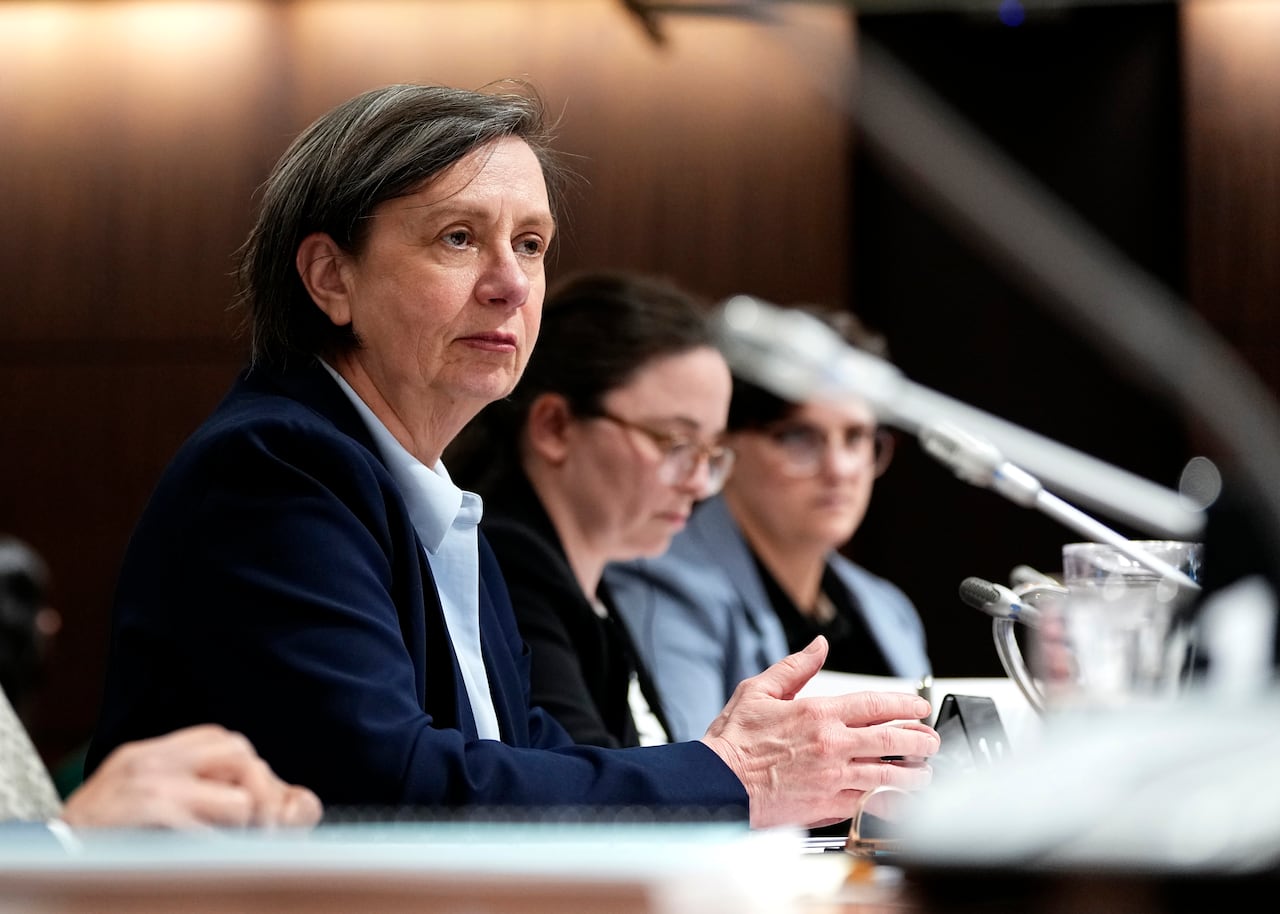
Parliamentary Budget Officer Annette Ryan prepares to appear at the Standing Committee on Government Operations and Estimates on Parliament Hill in Ottawa, on Tuesday, June 16, 2026. (Justin Tang/The Canadian Press)
Compared to the June outlook, the revised deficits are expected to be approximately $3 billion higher annually from 2026-27 to 2030-31, as new spending initiatives outweigh increased revenue, according to the watchdog.
Although the latest projections do not indicate a path towards balancing the overall budget, Carney has pledged to balance the “operating budget,” which encompasses the government’s day-to-day operational expenses.
Initially, the prime minister indicated that the government would achieve balance in this part of the budget by 2028. However, Carney announced in September that the government would reach an operating balance by 2027, a year ahead of the original timeline.
Nonetheless, a report from the PBO last month suggested that Ottawa may reach that target a year later, in the fiscal year 2029-30.
The PBO has also pointed out discrepancies in how government agencies categorize operational expenses versus investment expenditures.
Rising Inflation
The budget will be released as inflation rates have begun to rise again in recent months.
According to Statistics Canada, the annual inflation rate in Canada increased to 3.1 percent in September, up by 0.1 percent from August. StatsCan attributed this rise to higher fuel costs. Excluding gasoline, the consumer price index rose by 2.2 percent year-over-year in September.
The PBO mentioned on Tuesday that it predicts the Bank of Canada will commence raising its policy interest rate in early 2027 “to maintain anchored inflation expectations,” with a target of reaching 2.75 percent by mid-2027.
In terms of inflation, the watchdog anticipates that increased energy prices will keep the annual inflation rate elevated in 2026, averaging 2.8 percent, before declining to 2.4 percent in 2027.
The Bank of Canada aims for an inflation target between 1 and 3 percent.

