

Touch may be the most effective remedy for ailing coral.
Researchers at Stanford University in California made an intriguing discovery when two coral pieces in their lab — one that was bleached and another that was healthy — made contact by tipping over in a tank.
“We observed the healthy coral transferring vibrant, beneficial algae to the bleached corals, and we witnessed its color rejuvenate almost instantly,” ocean scientist Danny Collins shared with As It Happens guest host Dave Seglins.
In just a few weeks, Collins noted, the distressed coral had healed “to the point where it was indistinguishable from the healthy coral.”
“We were amazed,” Collins remarked. “This could potentially pave the way for coral reef restoration.”
The results, published this month in the journal Science Advances, offers renewed optimism as global coral reefs are on the brink of collapse. However, researchers warn that these findings are currently limited to laboratory conditions, and any restoration initiatives must be accompanied by conservation measures.

Vibrant coral reef ecosystems are brimming with vivid colors.
However, Collins explained that this color is not due to the corals themselves. Instead, it originates from beneficial algae, which are taken up into the coral’s tissues through photosynthesis and provide essential nutrients.
“The coral offers the habitat, while these algae supply the nourishment. This symbiotic relationship is fundamental to the productivity of coral reef ecosystems,” Collins stated.
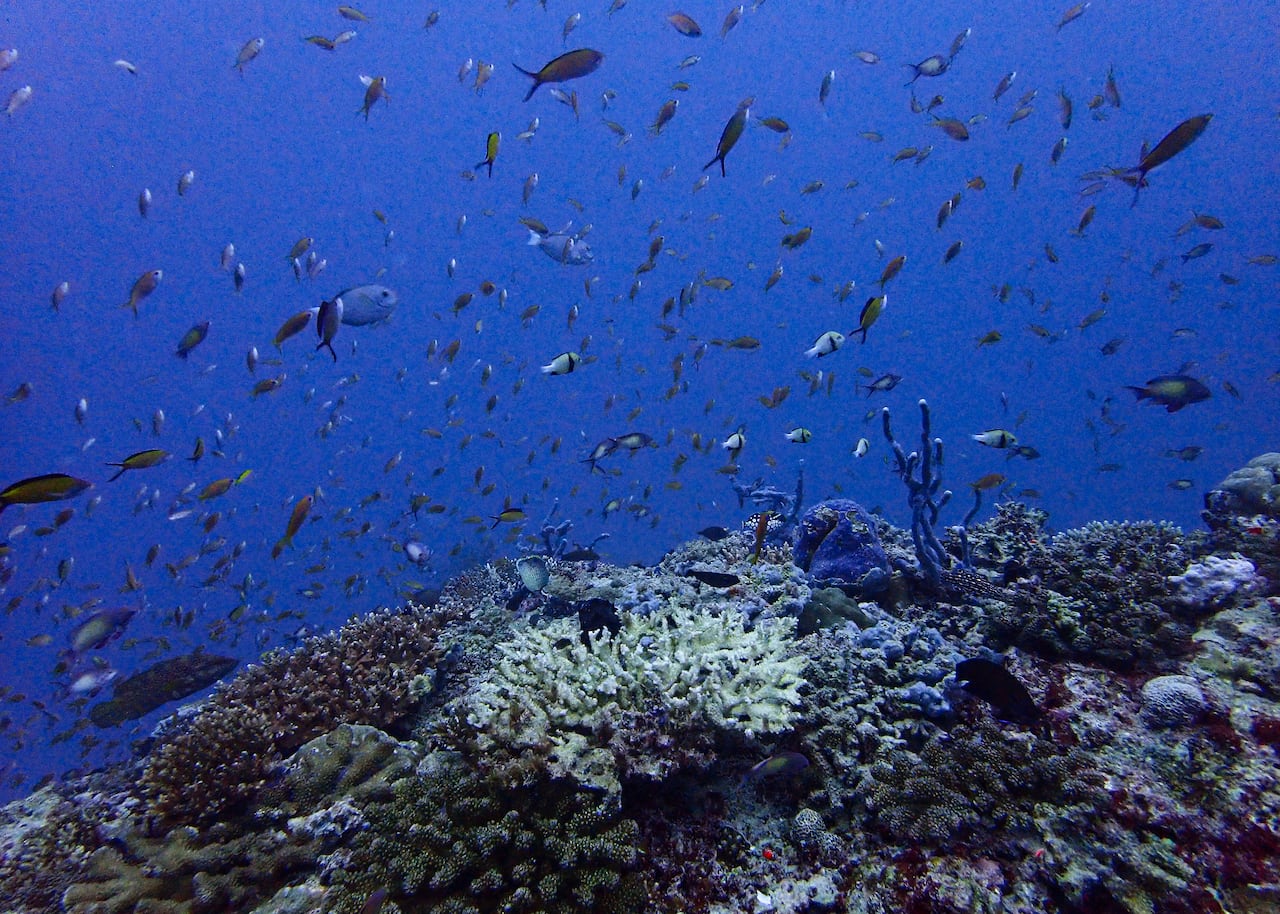
This underwater image captured in the Maldives in 2024 displays hard corals alongside a bleached coral branch surrounded by fish. (Sarah Lai/AFP/Getty Images)
“As water temperatures rise, both the coral and the algae experience stress. Consequently, these beneficial algae begin to release toxins that are harmful to the coral, leading it to expel the algae from its tissues in a fascinating response.”
This expulsion results in corals becoming bleached, malnourished, and teetering on the edge of death, a condition known as coral bleaching.
“We’ve shown that they aren’t dead. Moreover, they’ve demonstrated an impressive ability to recover swiftly,” Collins added.
Only functions with genetically similar corals
However, Collins notes that this does not imply that the coral bleaching issue has been resolved. The experiments have their constraints.
For instance, direct contact is essential. When the team placed the coral fragments just a few millimeters apart, there was no observable effect.
“It may sound like something out of science fiction, but the tissues of the healthy coral and the bleached coral actually merge,” he explained. “They form a tissue bridge that serves as a nutrient highway, enabling the healthy coral to transfer nutrients and vibrant algae to the bleached counterpart.”
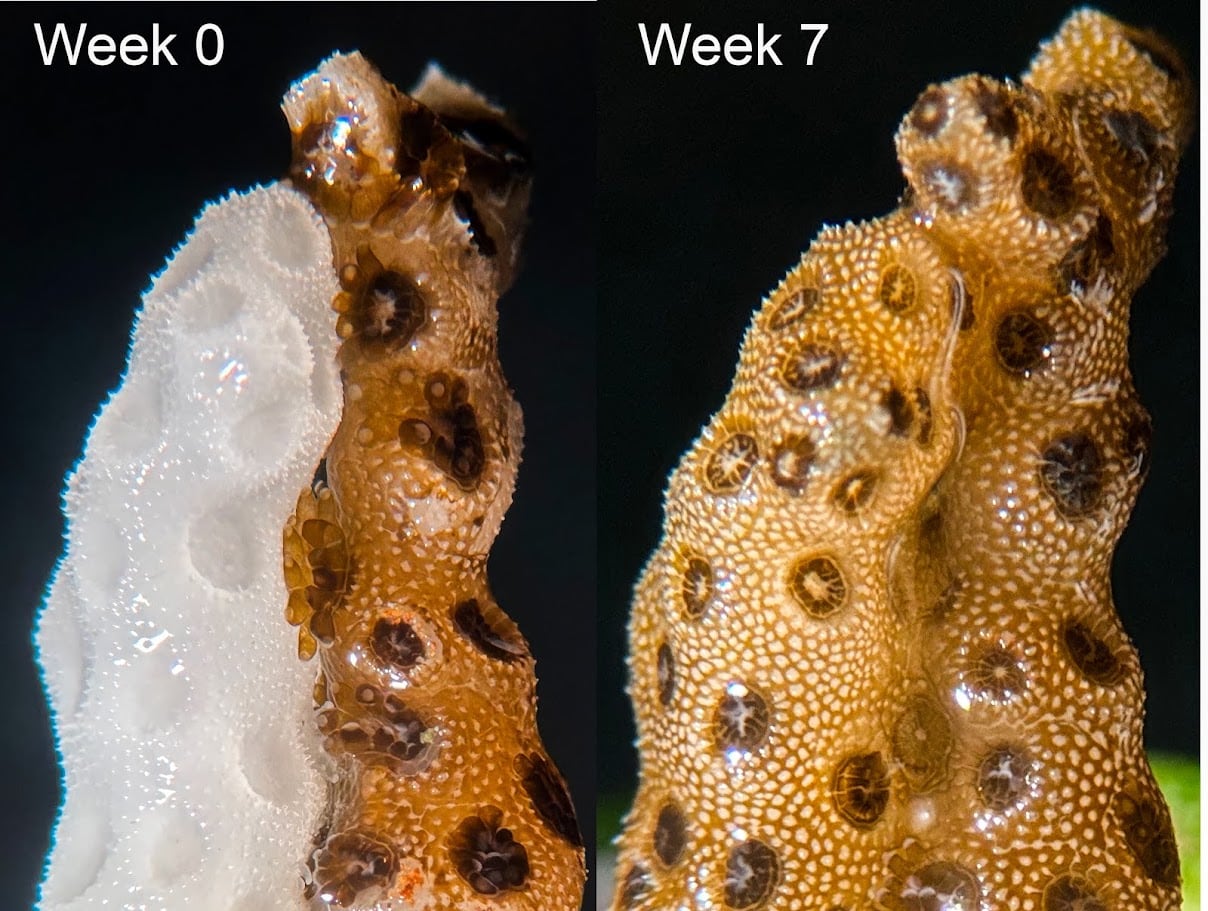
Researchers discovered that when a bleached coral comes into contact with a genetically identical clone, it recovers ‘to the point where it was indistinguishable from the healthy coral,’ according to Danny Collins from Stanford University. (Dannny Collins)
Furthermore, this process is effective only with genetically identical corals.
“When we placed them together with corals of different genetic backgrounds, we observed a fascinating immune response where the corals actually rejected each other, akin to an organ transplant rejection,” Collins noted.
He explained that this occurs because coral is a “colonial animal” — a living entity made up of thousands to millions of polyps.
“When genetically similar corals interact, they recognize each other and can actually merge,” he said.
“Fusion is advantageous on a reef; if a part breaks off during a strong wave, it can reconnect with itself.”
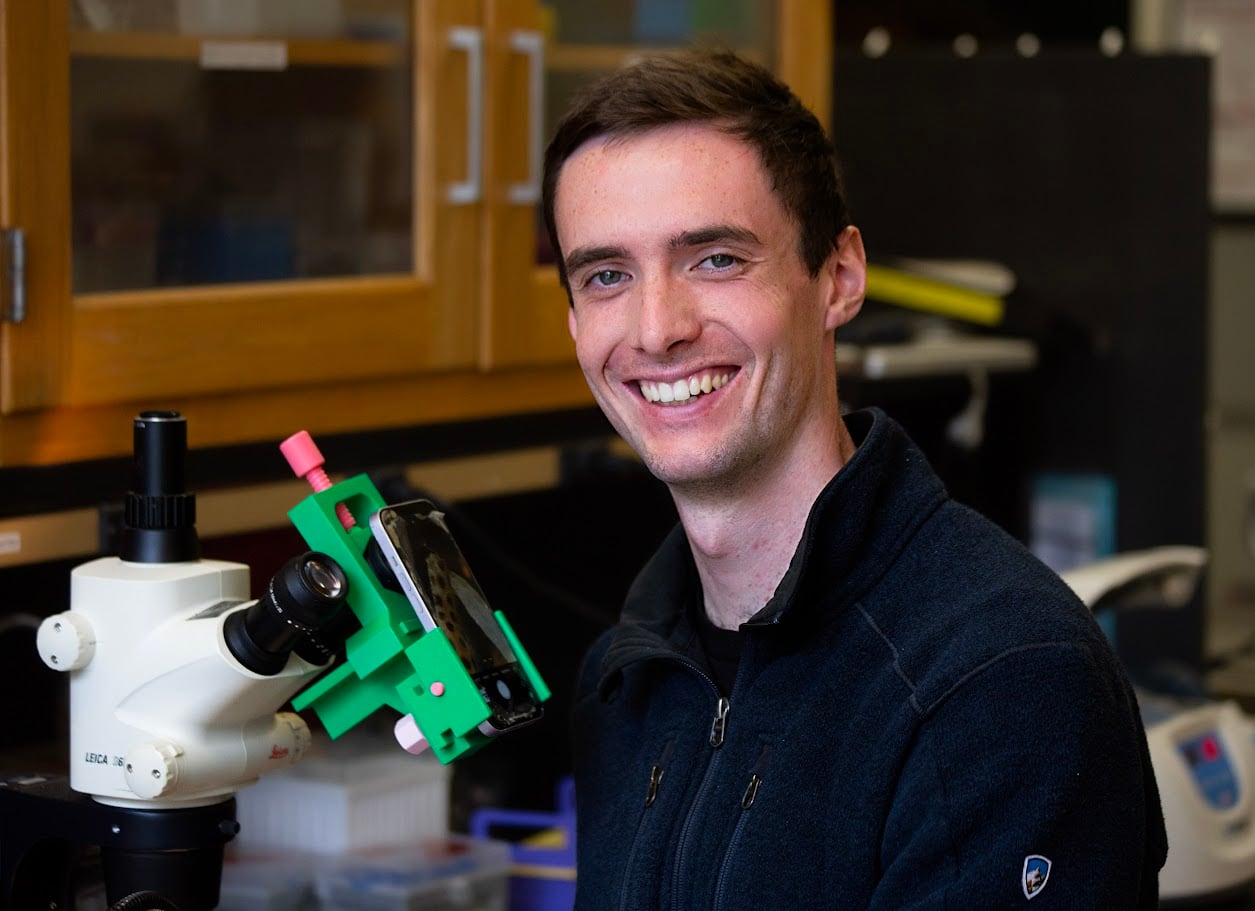
Danny Collins, an ocean scientist at Stanford University, states that his new research may offer a viable pathway for coral restoration. (Submitted by Danny Collins)
According to the International Union for Conservation of Nature, around 96 percent of the world’s shallow-water reef systems are critically endangered and could vanish by 2075, as announced during a UN biodiversity conference in Albania on Thursday.
This loss will have significant repercussions for biodiversity, tourism, and fisheries, as coral reefs serve as habitats for approximately a quarter to a third of all marine species.
‘Glimmer of hope’
The research from Stanford offers a “glimmer of hope” amid a slew of negative news, according to coral scientist Julia Cole, who was not part of the study.
“It’s incredibly exciting,” remarked Cole, chair of the Department of Earth and Environmental Sciences at the University of Michigan. “Nature can surprise us in unexpected ways sometimes.”
Nonetheless, she warns that there are significant challenges ahead.
“Considering the vast scale of reefs, which stretch kilometers, or in the case of the largest reefs, thousands of kilometers… a process that necessitates coral-to-coral contact would be a meticulous and potentially overwhelming endeavor.”
Collins mentioned that his team is exploring methods to extract algae from healthy reefs, culture it in laboratory settings, and utilize it to shield vulnerable reefs from anticipated bleaching events.
“Our aspiration is to develop interventions in the near future that could be implemented in the field and potentially scaled,” he stated.
-
Corals in decline globally, nearly half a century of data shows
-
In good news for coral reefs, scientists identify where the toughest ones are
Even if bleached corals can be healed, Cole emphasizes that rising ocean temperatures continue to pose a significant threat.
“We know how to address the rising temperatures causing these issues,” she stated. “It ultimately comes down to seriously reducing greenhouse gas emissions, moving away from fossil fuels, and transitioning to a clean-energy economy.”

