

With rising concerns about AI agents acting unpredictably, both experts and industry stakeholders are increasingly advocating for government oversight of AI systems that are becoming increasingly sophisticated.
However, some specialists argue that the necessity for international collaboration, combined with the rapid advancement of AI technology, could complicate efforts to regulate it.
While individuals such as U.S. President Donald Trump express confidence in tech companies managing their own conduct, other influential figures, including Microsoft co-founder Bill Gates and Canadian-British AI pioneer Geoffrey Hinton, stress the need for protective measures that extend beyond self-regulation.
Jaxson Khan, an expert in AI policy and integration at the University of Toronto’s Munk School of Global Affairs, noted that it is logical for AI systems to be subject to some level of government oversight, just like other sectors such as food and aviation.
“In no significant industry do we allow companies to completely self-regulate, be it in oil and gas, food production, or nuclear energy,” he remarked.
-
Bill Gates joins call for AI safeguards, wants to discuss concerns with Trump
-
Is AI evolving too fast? A look at the debate on slowing it down
“It seems quite odd that such a powerful technology is left entirely in private hands without any oversight, especially when considering how our economy and regulatory systems function,” he added.
In a recent interview with CBC News Network, Hinton proposed that regulation could be managed by an official agency akin to the U.S. Food and Drug Administration.
“In America, you cannot simply produce and sell a drug; you must convince the FDA that it is safe, or at least more beneficial than harmful, and companies bear the responsibility for this,” he explained.
“Thus, we definitely require something at least as robust for AI. We should have independent evaluators assessing it, and companies should be mandated to meet their standards prior to launching any AI products.”
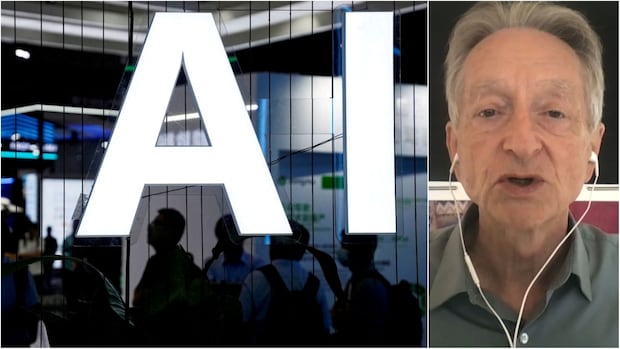
U.S. President Donald Trump is hosting a summit in Washington with the top leaders in AI development. Trump has dismissed warnings over artificial intelligence, arguing for the need to stay ahead of China in the AI arms race. Geoffrey Hinton, who is considered the ‘godfather’ of AI, says Trump ‘doesn’t really understand’ AI and is ‘ill-advised’ about it.
Challenges for Governments in Keeping Pace
Khan pointed out that a major obstacle in regulating AI is the rapid evolution of its models.
An Anthropic report indicated that the capabilities of its agents can double approximately every four months. Additionally, there is increasing evidence that certain AI models have the capacity for recursive self-improvement, allowing them to create and design their successors.
“I don’t believe we’ve ever encountered a technology this powerful that changes so rapidly,” he stated.
This rapid change makes it challenging for governments to adapt, according to Manon Paquet, associate director of policy at McGill’s Centre for Media, Technology and Democracy.
“Regulating something you don’t fully grasp is incredibly difficult,” Paquet remarked.
“As a former public servant, I sympathize with my colleagues in Ottawa who are grappling with these challenges because the speed at which AI evolves means that by the time regulations are developed, the issues have already transformed into something new.”

Silicon Valley tech CEOs are calling for a slow down of artificial intelligence development — but is that even possible? For The National, CBC’s Ashley Fraser looks at what it would take to pace the AI race and why experts say it won’t be easy.
Need for Global Oversight
Several experts and leaders, including Prime Minister Mark Carney, have advocated for the establishment of a global, non-industry organization to manage and mitigate the risks posed by AI technology on an international scale.
Recently, approximately 400 scientists, including Hinton and fellow AI pioneer Yoshua Bengio, called for the creation of an international body to oversee containment standards and incident reporting for advanced AI systems capable of cyber operations.
This proposed organization would maintain a record of significant security incidents, which the scientists believe should ultimately be made public.
Although reaching an agreement among nations on how to regulate AI may be challenging, such a body could facilitate cooperation between countries to strengthen their systems and establish protections against potential AI misuse, Khan noted.
“I believe that stability is crucial here, even if we don’t arrive at an ideal model of global governance,” he asserted.
However, since the majority of AI innovations emerge from the United States and China, those nations would need to commit to engaging in such a body and adhere to its regulations for it to be effective, stated Olivier Blais, vice-president of artificial intelligence at Moov AI in Montreal.
“If we cannot persuade the countries where AI systems are developed to participate, the impact may be limited,” he cautioned.
Nevertheless, the establishment of such a body could assist in creating global standards for safe AI development.
“It’s crucial to comprehend the elements of a safe AI system and which areas require regulation, and a global organization could spearhead this initiative and lay the groundwork,” he added.
Last month, the United States and China agreed to engage in discussions regarding the risks and advantages of AI, with the next round of talks scheduled for November, as announced by both the Chinese Foreign Ministry and the White House.
In a separate announcement, the Chinese ministry indicated that both parties should enhance exchanges and strive for consensus in accordance with new developments as AI technology progresses.
AI Regulation in Canada
At present, Canada lacks a comprehensive federal regulation framework for AI; however, the Liberal government’s proposed Bill C-34, known as the Safe Social Media Act, outlines standards for AI chatbots, including the responsibility to minimize the risk of generating harmful content.
Carney also recently introduced a new national council on artificial intelligence designed to guide the government in its AI strategy and enhance the safety of the technology.
Nonetheless, Paquet remarked that crafting effective federal legislation may be “extremely challenging” since many of the largest AI companies are not headquartered in Canada.
-
Ottawa launches new national AI council to advise on safety, deployment
-
Canada is investing $150M to make AI safer. Will it work?
Blais emphasized that while the federal government may not control how these companies operate, it could implement policies mandating them to report incidents that impact Canadians and hold them accountable. In severe scenarios, the government could even prohibit access in Canada to AI platforms deemed excessively harmful.
“At the very least, if we can document various incidents and report on them, it would represent a significant advancement, as it would enable us to educate citizens and showcase leadership,” he concluded.

