

The Norwegian Prime Minister has stated that threats from Russia are part of the contemporary security landscape and must be taken seriously.
In a discussion with CBC’s Power & Politics, Prime Minister Jonas Gahr Støre conveyed to host David Cochrane that “we are prepared, but not afraid” regarding a potential Russian invasion.
He emphasized that the threat is “real” and should be monitored “very carefully,” particularly by nations located near the Russian border, including Canada.
“Intelligence agencies from NATO member states are indicating that this threat is genuine. It is occurring,” Støre remarked.
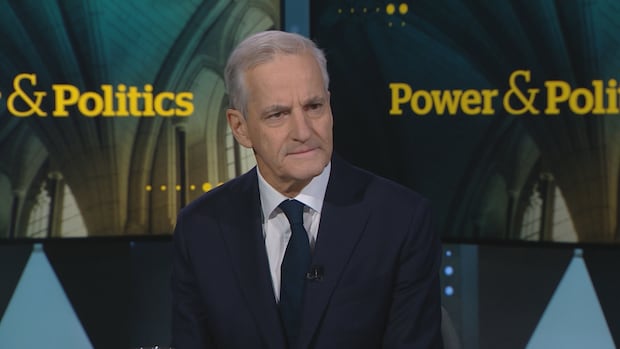
Norwegian Prime Minister Jonas Gahr Støre informs Power & Politics that the threat from Russia to bordering nations, including Canada, is ‘real’ and warrants careful monitoring by NATO allies.
This discussion regarding threats gained prominence this week following a warning from Polish Prime Minister Donald Tusk, who indicated that Russia is poised to carry out hybrid assaults on NATO territory.
In this context of heightened threat, the Prime Minister of Norway asserted that regional alliances must strengthen, praising Canada’s recent initiative to pursue membership in the U.K.-led Joint Expeditionary Force (JEF), a coalition of several NATO countries designed to enable quicker responses in times of crisis.
Initially established by the U.K., Netherlands, and Nordic and Baltic nations, Støre noted the importance of enhanced collaboration with nations that “share challenges and security risks,” including Poland, Germany, Belgium, and Canada.
-
Carney touts Arctic alliance with Norway during PM’s visit to Ottawa, amid Russia threat
-
Analysis
Russia is rattling NATO’s nerves, but how far will Moscow go?
Støre remarked that the JEF is beneficial for situations where challenges may exceed the capacity of a single nation or do not meet the threshold of Article 5 — the NATO provision mandating collective defense for any member under attack. He explained to Power & Politics that NATO allies are participating in a “sophisticated debate” regarding when Article 5 should be activated.
With Russia facing difficulties in achieving its objectives in Ukraine, it may be looking to test its partners, Støre suggested.
Events in Europe over the summer have heightened concerns among NATO allies.
Authorities in Germany attributed a drone strike at an airport in central Germany in August to Russia, while Bulgarian officials recently announced an investigation into a fire at a munitions depot linked to arms manufacturer EMCO, whose products are utilized in Ukraine.
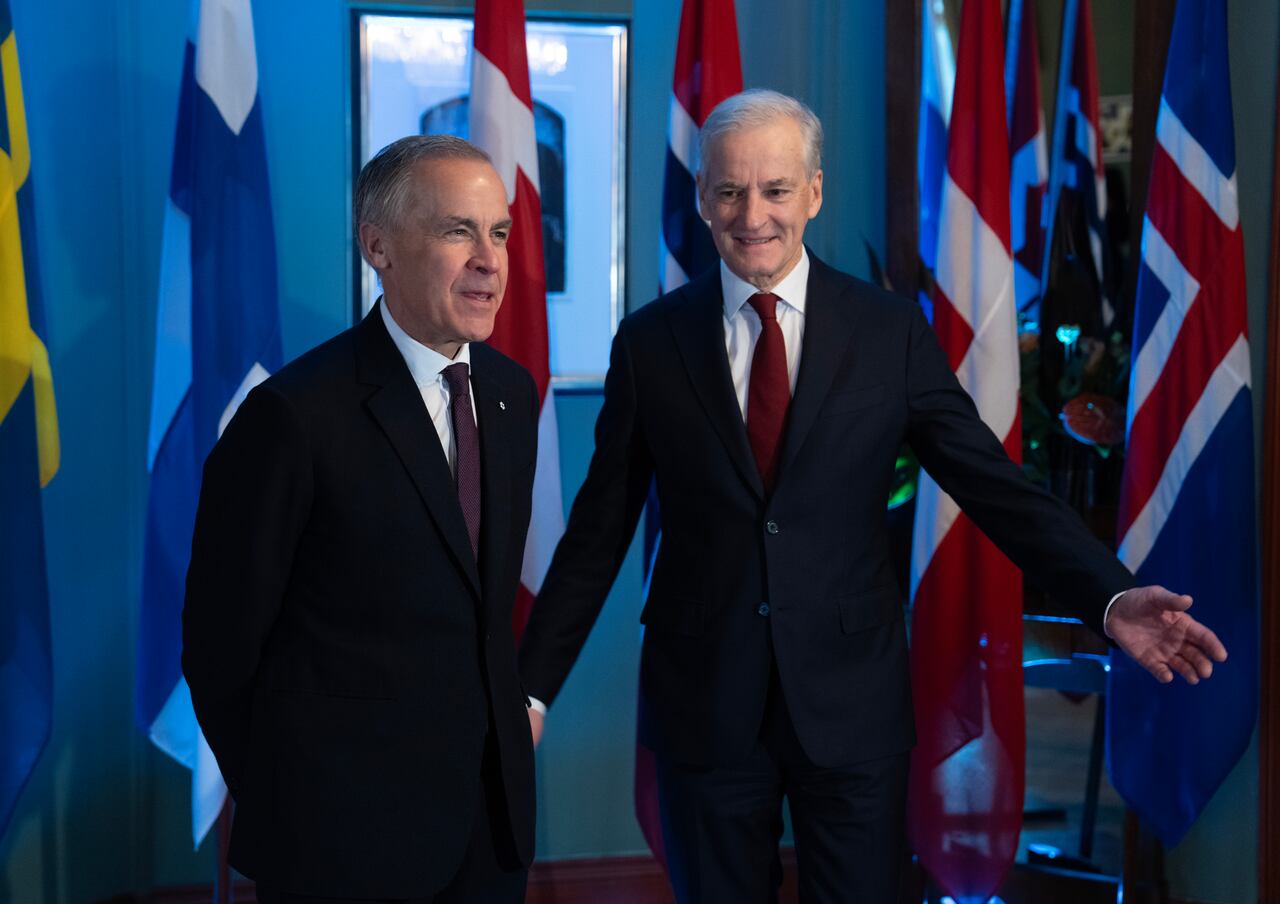
Støre, right, welcomes Carney as he arrives at the Canada-Nordic Summit at Government House in Oslo, Norway, in March. Both nations established a strategic partnership following the visit, significantly broadening cooperation areas. (Adrian Wyld/The Canadian Press)
Norway seeks partnership with Canada in the Arctic
After Prime Minister Mark Carney’s trip to Norway in March, both nations entered into a strategic partnership aimed at significantly enhancing cooperation across various domains, particularly in the Arctic where both share a coastline with Russia.
Støre remarked, “We view Canada as a crucial part of the Northern region. The Atlantic lies between us, yet we are Arctic nations.”
With Russia not being a partner in the Arctic, Canada and Norway must remain “very, very closely connected” to uphold stability in the North.
In July, Carney opted to procure a dozen submarines from a European manufacturer rather than a Korean company after a prolonged and competitive bidding process. This selected collaboration involves a German firm in partnership with Norway, with all three countries working together to produce and maintain the submarines.
Støre noted that interoperability among submarines is a “major advancement” for enhancing Arctic security, as well as for collaborative industrial research related to the Arctic.
“This is why we need to focus on our coast guards and enhance our capabilities for surveillance in space. This is an exciting area of collaboration between Norway and Canada.”
Carney engages with Europe
The visit by the Norwegian delegation follows Carney’s speech to the European Parliament in Strasbourg, France, subsequent discussions with U.K. Prime Minister Andy Burnham in Liverpool, England, and a meeting with French President Emmanuel Macron on Saint-Pierre-et-Miquelon, a French territory located 20 kilometers off the southern coast of Newfoundland.
What about the possibility of “associate membership” with the EU?
Støre expressed his support for “deeper connections” with Canada, but emphasized the need for these to be “genuine” and “meaningful.”
As the most integrated non-EU country in Europe, Støre stated that Canada, the U.K., and Norway should collaborate more closely with the EU on emerging topics that necessitate cooperation, such as space, critical minerals, energy, and artificial intelligence.
“We can all gain from this and avoid falling into bureaucracy and regulations that can complicate matters.”

