

A prominent economic think-tank in the country has raised concerns that the federal government must create a “credible fiscal plan” to address the consequences of significantly increased defence expenditures.
The CD Howe Institute’s latest report, published on Thursday, indicates that achieving NATO’s new target of five percent of the gross domestic product—comprising 3.5 percent for direct military spending and 1.5 percent for defence infrastructure—represents a significant shift in the federal budget.
Colin Busby, the policy engagement director at the institute, noted that the projected $150 billion annually for defence is comparable to what the government allocates for health and education transfers to provinces.
The institute recommends a slight increase in the Goods and Services Tax (GST) and a limitation on the growth of non-defence spending and provincial transfers as a practical approach.
-
Canada clears NATO’s 2% bar — after years of lagging and a last-minute lift
-
NATO’s new defence target could add $63B to federal deficit, PBO warns
“The optimal moment to engage in this discussion is now, as the credibility of this fiscal plan is crucial,” Busby expressed during an interview with CBC News.
Last week, Prime Minister Mark Carney’s administration revealed it had reached the significant milestone of allocating two percent of GDP for defence after a prolonged period of Canada missing that target.
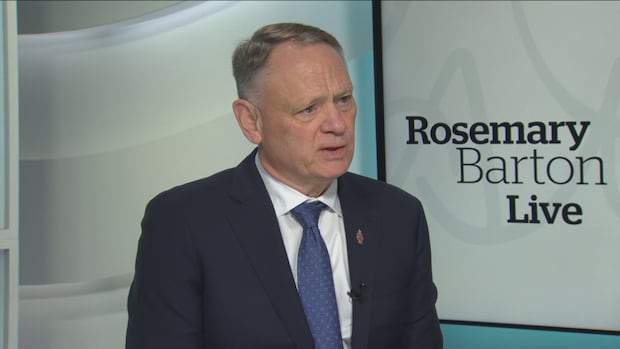
For the first time since the 80’s, and after much pressure, Canada has hit NATO’s defence spending target. Minister of National Defence David McGuinty speaks to CBC News Chief Political Correspondent Rosemary Barton about how Canada achieved the milestone.
Next NATO goal is 5%
However, NATO leaders last year established a new five percent target to be met within the next ten years.
Carney contends that investments in defence, particularly in dual-use technology, will yield economic benefits. Still, after the previous year’s NATO summit, he acknowledged that there might be “trade-offs” later in the decade as spending escalates, necessitating “social licence” from Canadians.
Busby expressed concern that the recent federal budget, unveiled last November, did not include a long-term strategy for managing the substantial increase in defence spending in relation to other federal expenditures.
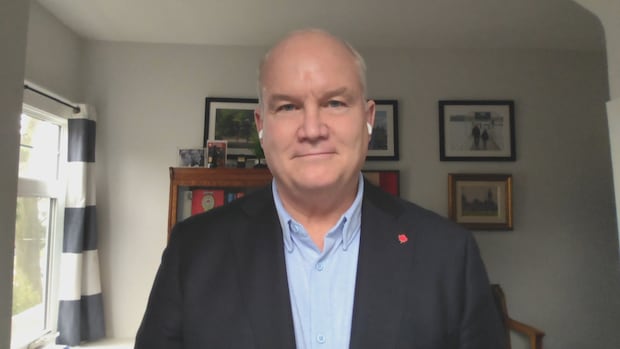
U.S. President Donald Trump is lashing out at NATO, calling allies ‘cowards’ for not supporting the U.S.-Israel war in Iran. These comments come as Canada signs a joint statement with six other allies saying it’s ready to help protect the Strait of Hormuz. Erin O’Toole, former veterans affairs minister and retired captain in the Royal Canadian Air Force, joins Power & Politics to discuss.
In fact, Finance Minister François-Philippe Champagne’s fiscal strategy lacked a five-year outlook for defence spending, a departure from previous budgets. It merely indicated a total increase of $81.8 billion for the Department of National Defence over the next five years.
Since the budget announcement, the Department of National Defence has declined to provide a year-by-year forecast of the expected increase in defence funding.
-
Foreign Affairs Minister Anand says NATO must turn its focus to the North
-
Carney announces $35B for defence, infrastructure in Canada’s North
“There are numerous questions that arise regarding our current situation,” Busby stated, adding that without data, those concerned with public finances will need to make assumptions.
Increases a concern across NATO alliance
The challenge of financing the substantial increases is a widespread concern within the NATO alliance, according to Busby.
“I worry not only about Canada but also other nations delaying this issue and resorting to debt to cover the entire increase,” he remarked. “Consequently, we can observe several NATO members facing significant fiscal difficulties.”
Countries like France and Italy are anticipated to struggle to meet the new NATO standard due to their high public debt levels. The French government has already dismissed the possibility of raising taxes.
The United Kingdom and Germany are also grappling with how to achieve the five percent goal. London, in particular, faces significant budget limitations while Berlin is dealing with pressing spending requirements.

