


The ongoing debates in the Supreme Court regarding Quebec’s secularism law, Bill 21, have highlighted a nationwide disagreement on the role of courts in interpreting the notwithstanding clause.
Bill 21 prohibits certain public servants, such as teachers, from wearing religious symbols while on duty.
Quebec utilized the notwithstanding clause as a preemptive measure when drafting the law to protect it from legal challenges.
The notwithstanding clause, found in Section 33 of the Charter of Rights and Freedoms, permits provinces to pass legislation even if it infringes on specific Charter rights.
During the Supreme Court session on Wednesday, the federal government — along with Manitoba and British Columbia — argued that even when the notwithstanding clause is preemptively invoked, courts should retain the authority to provide non-binding assessments on whether a law breaches the Charter, despite these assessments lacking the power to nullify the law.
In contrast, Quebec, Alberta, and Ontario strongly oppose this stance.
This division was evident during the court proceedings on Wednesday.
Ontario’s Attorney General, Doug Downey, conveyed the province’s stance that once Section 33 is invoked, courts should refrain from commenting on the law’s constitutionality without the invocation.
Deborah Carlson, representing the Attorney General of Manitoba, challenged this perspective in her address to the court.
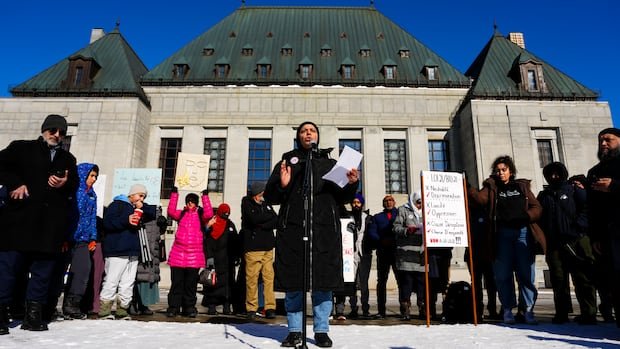
Much of the legal debate around Quebec’s Bill 21 centers on the province’s use of the notwithstanding clause in the text of the law, intended to preempt legal challenges. Opponents of the law argue it sets a precedent for broader notwithstanding clause utilization, which can temporarily override certain Charter provisions.
Should courts have a say?
Groups challenging Bill 21 in court argue that the notwithstanding clause was not meant for preemptive use.
In typical scenarios involving the clause, provincial governments pass a law, it faces a legal challenge, the court deems it unconstitutional, and only then does a province invoke the notwithstanding clause.
Opponents of Bill 21 insist that courts must identify the Charter rights infringement before provinces resort to the clause.
Quebec’s primary argument against this is the absence of any Charter provision prohibiting preemptive invocation of the clause.
Lower courts have supported this argument.
Some opponents of the law urge the Supreme Court to allow courts to provide non-binding opinions, even if the court upholds the clause’s preemptive use.
