

On Wednesday, Prime Minister Mark Carney, along with Ontario Premier Doug Ford, unveiled an $8.7 billion financial assistance plan aimed at the steel, critical minerals, and automotive sectors.
According to Ford, the agreement between the federal and provincial governments “will safeguard jobs in vital industries across the province from tariffs and will create new well-paying employment opportunities” throughout Ontario.
This collaboration designates $2.5 billion over a two-year period specifically for Ontario’s automotive sector to develop the “connected and electric vehicles of the future.”
Of the funding allocated for the automotive industry, Ottawa is contributing $1.5 billion, while Ontario will add $1 billion.
This backing for automotive firms arrives amidst growing unease due to the ongoing trade dispute with the United States.
“A unified North American automotive industry will be more resilient, competitive, and will offer enhanced job opportunities for our workforce,” Carney stated. “However, we acknowledge that these are not the priorities of the current U.S. administration. Their stance has shifted, and we need to adjust accordingly.”
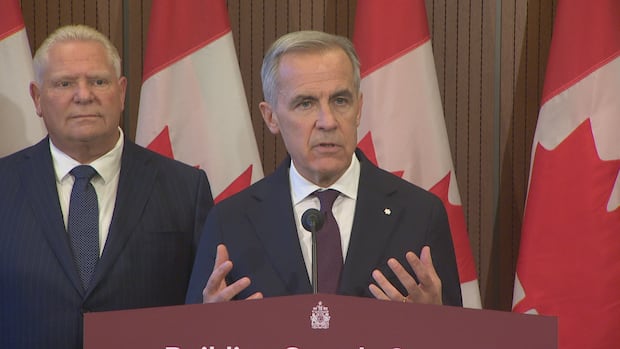
In a joint announcement with Ontario Premier Doug Ford, Prime Minister Mark Carney stated that new investments in Ontario’s Ring of Fire critical minerals projects, along with the steel and auto sectors, will safeguard up to 290,000 jobs throughout the province.
In August, U.S. President Donald Trump threatened to raise tariffs on all automobiles, trucks, auto parts, and steel to 50 percent starting January 1. This warning followed Carney’s declaration of retaliatory tariffs on American imports, matching dollar for dollar.
Currently, the U.S. imposes a 25 percent tariff on imported finished vehicles and non-CUSMA-compliant auto parts.
“Ontario and Canada are currently facing significant challenges,” Ford remarked. “We can observe the impact in every part of our province where tariffs and trade uncertainties are causing anxiety for workers and their families.”
Additionally, as part of the collaborative initiative, Ottawa is softening greenhouse gas regulations in response to U.S. tariffs affecting Canada’s automotive industry.
Canada’s emission standards will remain unchanged until 2030, keeping the 2026 levels for new light-duty vehicles through the 2029 model year, with annual increases expected to resume in 2030.
Initially, Ottawa had suggested raising emissions standards from 2026 to 2035 to meet its target of 75 percent electric vehicle sales by 2035.
Brian Kingston, president of the Canadian Vehicle Manufacturers’ Association, stated that this move will offer “some relief” to the automotive sector.
“By pausing the regulation and maintaining the status quo until 2030, companies gain flexibility as they confront a far more significant threat, namely U.S. tariffs,” Kingston explained.
Conversely, Evan Pivnick, associate director of public affairs at Clean Energy Canada, expressed that this adjustment is a drawback for the government’s electric vehicle sales objectives.
Pivnick pointed out that while Carney acknowledges the global transition to electric vehicle adoption, “the policies designed to ensure Canadians can access a larger share are simply postponed.”
Ottawa’s relaxed emissions standards follow the Trump administration’s recent similar alterations on Monday.
The U.S. has finalized a rollback of fuel economy standards for new vehicles, reversing measures aimed at enhancing fuel efficiency and encouraging electric vehicle usage.
Given the close integration of the Canadian automotive industry with the U.S., Kingston noted that Canada must remain “fairly aligned” with its southern neighbor in this regard.
“If we aim to maintain an industry of our current size and scale in Canada, we cannot diverge significantly from the United States,” Kingston remarked.
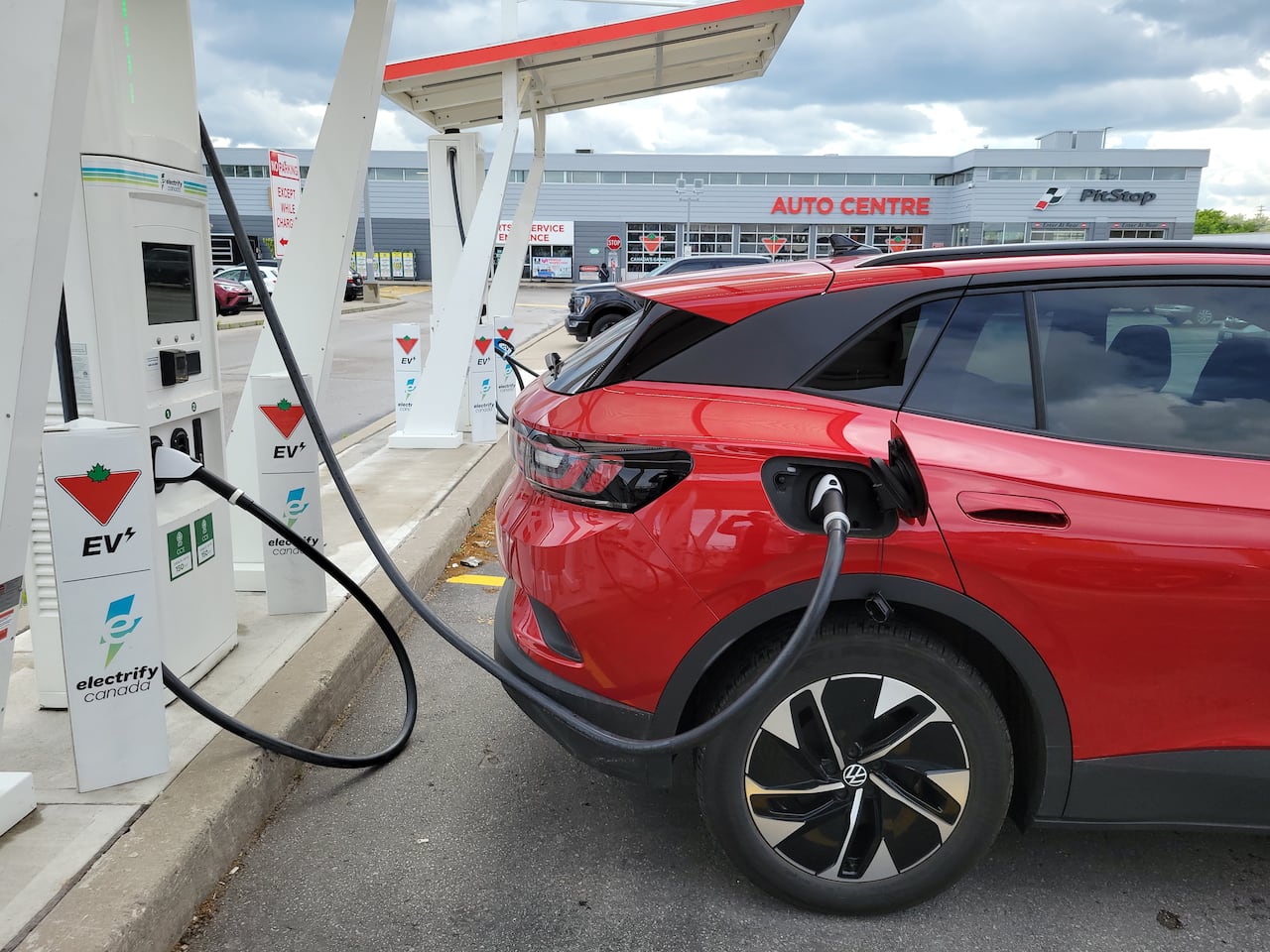
The Carney administration aims for three out of every four new vehicles sold in Canada to be electric by 2035. (Doug Ives/The Canadian Press)
On Wednesday, Industry Minister Mélanie Joly, while entering a caucus meeting, stated that the government aims to continue supporting automotive companies affected by the regulatory changes of the Trump administration.
“Numerous auto producers have been severely affected, not just by American tariffs but also by the significant reduction in various protections regarding GHG emissions decided by the American administration,” Joly stated.
Carney emphasized that Canada’s need to invest in cleaner automotive technologies is “strengthened by the dramatic transformation of the global auto sector” towards lower emissions, enhanced connectivity, and advanced manufacturing.
He added that this investment marks “the next significant advancement” in establishing Canada as a global leader in electric vehicle production.
Initiatives for steel and critical minerals
The federal and provincial partnership also introduces a $5 billion Joint Steel Action Fund, with $3.55 billion from Ottawa and $1.67 billion from Ontario, spread over five years.
Carney stated that this investment will enable steel mills to modernize their equipment, produce more essential products for Canada, and expand to cater to demand from markets beyond the U.S.
“When Canadian projects require specialized steel, they can increasingly rely on Canadian mills and steelworkers for supply,” Carney remarked.
Additionally, Ottawa is committing $1 billion over three years to match Ontario’s investment in constructing a road to access the mineral-rich Ring of Fire area.
-
Auto industry reacts to Trump’s new tariff threats
-
No trade deal expected before U.S. midterms: sources
Ontario has been seeking federal assistance to expedite the development of the Ring of Fire region.
Ford has referred to the extraction of critical minerals in this area as an “ace in the hole” that could enhance Canada’s position against American tariffs.
Carney mentioned that Ottawa and Ontario are establishing a coordinated approach for the permitting process to facilitate mine openings. He noted that historically, the process of opening a mine in Ontario has exceeded 15 years.
Tag: rewrite-pending

