


Amid the closure of the critical Strait of Hormuz due to the ongoing conflict in the Middle East, the global community is turning to its oil reserves to address the supply disruption.
Recently, the International Energy Agency (IEA) announced its decision to release 400 million barrels from its emergency reserves, marking its largest-ever release, to mitigate the significant disruption caused by the conflict, as stated by the IEA.
Attention is now focused on Canada’s oil reserves, or rather, the absence of such reserves, as Canada stands out as the only G7 nation without a strategic reserve.
While Natural Resources Minister Tim Hodgson expressed Canada’s commitment to assisting in global oil supply, Conservative Party Leader Pierre Poilievre criticized the Liberal government for the lack of reserves, highlighting that Canada currently has no stockpiles, as mentioned during a heated exchange with the prime minister on Wednesday.
So, why does Canada lack a strategic reserve, and what steps can the country take to contribute to the global supply? Here’s what you should know.
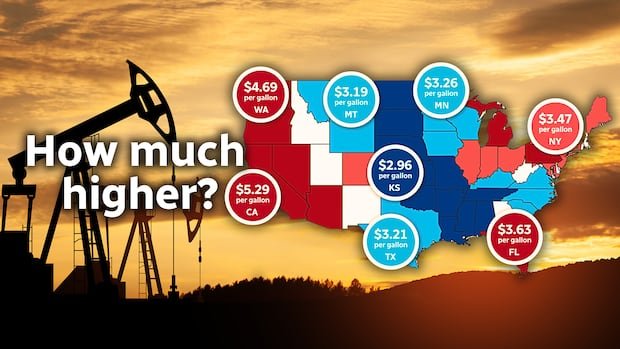
Oil and gas prices are rapidly rising around the world amid the U.S.-Israel war with Iran. Andrew Chang explains what’s driving the surge and why predicting the next moves in the oil market is so difficult.
CORRECTION (March 11, 2026): At 2:36 in this video, the graphic incorrectly states Iran holds 298 billion barrels of oil reserves. The correct number is 209 billion.
Images provided by The Canadian Press, Reuters and Getty Images.
Why the absence of reserves in Canada?
Canada is one of the 32 member countries of the IEA, which was established in 1974 to coordinate an international response to the energy crisis triggered by the Arab oil embargo at that time.
The IEA member countries collectively hold over 1.2 billion barrels of public emergency oil stocks, complemented by an additional 600 million barrels of industry stocks subject to government obligations.
While the IEA mandates that member nations maintain reserves equivalent to 90 days of net imports, Canada is exempt from this requirement due to its status as a net oil exporter.
Although the U.S. also falls under the net exporter category, it maintains a strategic reserve. The U.S. is set to access approximately 174 million barrels from its reserves starting in the upcoming week.
While a significant portion of Canada’s oil is directed to the U.S., some oil from the Trans Mountain pipeline serves Asian markets, which are particularly impacted by the closure of the Strait of Hormuz, as noted in reports.
What steps can Canada take?</
